
Portfolio Building Policy
marimo REIT aims to secure both “relatively high investment yield” and “stable earnings” by building a portfolio of mainly residential and retail properties centering on regional areas, and also comprehensively investing in hotel, office, logistics, healthcare and parking properties to realize contribution to its basic principle of “regional revitalization.”
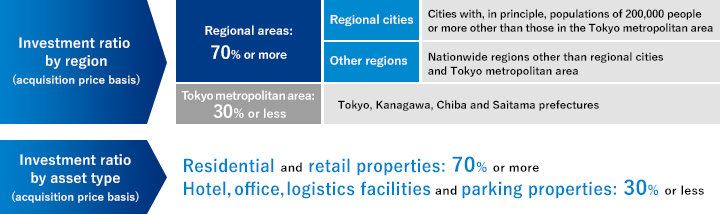
Investment Criteria for “Residential” Properties
| Investment areas |
|
||||
|---|---|---|---|---|---|
| Investment criteria |
|
||||
| Investment targets |
Single | Exclusive area per unit of less than 35㎡ |
Distance from the nearest station (or major bus stop (Note 1)) of within a 10-minute walk as a guide. However, not limited to this in the case of locations that are expected to be able to secure stable occupancy being within commuting distance of a university or other educational facility, etc. (within a 10-minute bicycle ride (Note 2)). | ||
| Compact | Exclusive area per unit of 35㎡ or more, but less than 50㎡ |
Distance from the nearest station (or major bus stop) of within a 15-minute walk as a guide. However, not limited to this in the case of locations that are expected to be regions with good living environment and high convenience in terms of daily living, such as there being supermarkets or other retail properties with potential for regional contribution in the neighborhood. | |||
| Family | Exclusive area per unit of 50㎡ or more |
||||
| marimo REIT invests in residential properties ranging widely from single type to family type (Note 3). | |||||
| (Note 1) | “Major bus stop” refers to a bus stop with regular bus service throughout the day and used for commuting to work or school on a daily basis. |
|---|---|
| (Note 2) | The time required by bicycle is calculated by the time when traveling at a speed of 250 m per minute (rounded up to the specified unit). |
| (Note 3) | The type of property shall be determined based on which range of exclusive area per unit that the most number of units fall under out of the three ranges: (i) less than 35㎡, (ii) 35㎡ or more, but less than 50㎡, and (iii) 50㎡ or more. |
Investment Criteria for “Retail” Properties
| Investment areas |
|
|||||||||
|---|---|---|---|---|---|---|---|---|---|---|
| Investment criteria |
|
|||||||||
| Investment targets |
Retail properties with potential for regional contribution | |||||||||
| Specialty stores (SS) | Neighborhood shopping centers (NSC) | Regional shopping centers (RSC) | ||||||||
|
|
|
||||||||
| Location based on trade area analysis | ||||||||||
| Location with high population density of 10,000 people or more in trade area population within 1 km trade area | Location with high population density of 50,000 people or more in trade area population within 5 km trade area | Location with high population density of 200,000 people or more in trade area population within 10 km trade area | ||||||||
Investment Criteria for “Hotel” Properties
| Investment areas |
|
||||||||
|---|---|---|---|---|---|---|---|---|---|
| Investment criteria |
|
||||||||
| Investment targets |
|
||||||||
| (Note 1) | As a general rule, the portion of variable rent may be set at up to 30% of the total rent. Such variable rent shall be calculated based on factors such as sales or GOP (Gross Operating Profit, meaning, in principle, the amount remaining after deducting hotel operating expenses from hotel revenues) for the most recent one-year period immediately prior to the decision to acquire the property or the execution of the lease agreement. However, for properties with an operating history of less than one year, the variable rent shall be calculated based on projected sales, projected GOP, or similar indicators. |
|---|---|
| (Note 2) | A “Shared-Use Mixed-Use Hotel” refers to a hotel that provides not only hotel spaces and facilities, but also a platform for sharing ideas, knowledge, lifestyles, and values among a diverse range of hotel users. |
Investment Criteria for “Office” Properties
| Investment areas |
|
|||||||||||
|---|---|---|---|---|---|---|---|---|---|---|---|---|
| Investment criteria |
|
|||||||||||
Investment Criteria for “Logistics” Properties
| Investment areas |
|
|||||||
|---|---|---|---|---|---|---|---|---|
| Investment criteria |
|
|||||||
| Investment targets |
BTS (Build-to-Suit) |
Logistics facilities built to meet the needs of a specific tenant, while ensuring sufficient versatility to accommodate future tenant changes. | ||||||
| Multi-tenant type | Versatile logistics facilities located in prime logistics areas, suitable for multiple tenants and various industries, with optimal scale, grade, and specifications for the location. | |||||||
| Last-mile type | Logistics facilities designed for the delivery of goods from the final distribution point to end users. | |||||||
Investment Criteria for “Healthcare” Properties
| Investment areas |
|
|||||||
|---|---|---|---|---|---|---|---|---|
| Investment criteria |
|
|||||||
| Investment targets |
Assisted Living Facility with Nursing Care |
Facilities for elderly persons defined under Article 29 of the Act on Social Welfare for the Elderly, which are designated to provide “Long-Term Care Services for Residents of Specified Facilities” and satisfy the required standards for the provision of nursing care services. | ||||||
| Residential Fee-Based Home for the Elderly |
Facilities for elderly persons as stipulated in Article 29 of the Act on Social Welfare for the Elderly, where residents, as a general rule, receive nursing care services through external care service providers. | |||||||
| Service-Added Housing for the Elderly |
The term refers to “Service-Added Housing for the Elderly” as stipulated in Article 5 of the Act on Securing Stable Housing for the Elderly. With respect to nursing care services, residents shall, as a general rule, use care services provided by external service providers. | |||||||
- Related Links
- Portfolio Map
- Portfolio List
- Portfolio Data